Politicians Suddenly Notice Everybody Hates Data Centers
And, suddenly, so do politicians!


Fresh off freezing up on a question on Taiwan at a primary debate this week, Sen. Darline Graham hustled to Sean Hannity’s Fox News show last night for a little damage control. “I don’t speak politician,” she said by way of explanation. “I think people in South Carolina are more worried about making ends meet. They’re concerned about boys in girls’ sports. One lady talked to me extensively about that today. They’re concerned about the Second Amendment, they’re concerned about the Save America Act, illegal immigration. So they’re concerned about a lot of other things other than Taiwan.” She doesn’t speak politician yet, but she’s trying to learn. Happy Thursday.

A Data Center? In This Economy?
by Andrew Egger
A few months ago, I went to an after-work D.C. event for folks in the AI space. The drinks were flowing and the vibe was cheery, mostly young would-be tech tycoons talking their book with chipper GOP policy staffers. But at one point, I talked to a different sort of character—a rumpled older guy who turned out to be an academic researching public attitudes toward AI development. How was that going, I asked. He looked at me with haunted eyes. It is so, so much worse out there, he said, than anybody even realizes.
What a difference a few months can make. Across the country, politicians are waking up to a simple fact: Voters hate AI and are gearing up to punish elected officials who seem to like it. Mostly, their ire has come to land on data centers—the factory-size banks of chips that power the cloud-based internet and are its most visible real-world incarnation.
Everywhere you look, politicians are suddenly sprinting away from data centers. Texas Gov. Greg Abbott, who had formerly rolled out the red carpet for the AI buildout, signed a moratorium on new data centers this month pending a state “audit” on their energy use. Just last night, Abbott bragged about having “halted up to 1,800 data center projects.” Pennsylvania Gov. Josh Shapiro followed Abbott’s lead this week, inking an order heaping up red tape on new proposed data centers. He, too, was until recently a fan.
This week, the National Republican Senatorial Committee raised the alarm explicitly in a memo about the Ohio Senate race, where Republican Sen. Jon Husted is trying to stave off a challenge from Democratic former Sen. Sherrod Brown. “Ohio is one of the leaders in building these AI factories,” reads the memo, which was first reported by Axios:
Brown has made his opposition to them the centerpiece of his campaign against Husted. Brown is using it because it works. More than any other thing in this race, data centers are the anchor hanging around Husted’s neck. If he loses and data centers get the blame, politicians across the country will take notice.
But it’s not only Democrats making use of this attack. In Wisconsin’s Democratic gubernatorial primary, Francesca Hong ran hard against data centers, while her opponent David Crowley took a more centrist approach: Not to ban them, but to require they be powered by green energy and built by union workers. Now that Crowley is through to the general, however, Republican Tom Tiffany is hitting him hard on the issue, describing him as “Data Center David Crowley” in ads: “Crowley’s campaign is funded by the people building them. Big Tech wins. Wisconsin pays.”
If you’ve been paying attention, it’s been clear for a while that we were heading here. Back in March, I wrote about the massive latent political energy surrounding AI, noting that neither party had yet won voters’ trust on the issue. “The party that can win the argument over AI is set up for a political windfall,” I wrote, “and then will be tasked with shepherding the country through massive disruption toward a prosperous rather than a dystopian AI-integrated future, if possible.”
The problem is that public hysteria over data centers has reached the point that there’s essentially no debate happening at all. Politicians are simply turning the phrase into low-calorie ragebait: If my opponent won’t pledge to stop letting companies plug in a bunch of chips in a warehouse, that’s because they’re owned by Big Data Center.
AI has remarkable potential for good: The tech’s capabilities just keep growing, and it is already paying major dividends in fields like medical research. And of course, AI has incredible potential for harm—it could eventually kill us all, or enslave us, or just feed us slop until it turns all our brains into soup. It’s a pretty big range of possible outcomes!
But while there are certainly good reasons to be anxious about AI development, concerns about data centers’ local effects are often wildly overblown. There’s something bleak about seeing the policy debate over how we ought to shape and regulate this massive, unbelievable, titanic technology collapse down into what’s essentially a NIMBY squabble over where to park the chips that power it.
Michigan’s Green Ghost
by Brendan Hartnett
As The Bulwark first reported, the Green Party of Michigan may have nominated a Republican plant to run on its ballot line in Michigan’s competitive 7th Congressional District. Our investigation uncovered that 25-year-old Shane Dedrick was chosen as the party’s nominee after joining the Green Party of Michigan’s April nominating convention on Zoom—during which he kept his camera off, seemed to know little about the party platform, and went through practically no vetting. Dedrick is not active on social media, does not have a campaign website, and has yet to register with the FEC.
Despite multiple attempts, The Bulwark was unable to get in contact with Dedrick. We’re not alone.
Following our story, Michigan’s WLNS reached out to Dedrick unsuccessfully and even visited his residence, but no one came to the door. Douglas Marsh, communications director for the Michigan Greens, told WLNS, “To my knowledge, no one has heard from him since April 25,” when Dedrick first introduced himself to the party, never showed his face, and left 33 minutes later as the party’s nominee. Marsh told The Bulwark that he has still not been able to contact Dedrick.
Initially, that didn’t stop the Michigan Greens from continuing to promote Dedrick on social media. However, in recent days, the party has not included Dedrick in its posts advertising its slate of candidates.
On Wednesday, the party even posted a quote from its secretary of state nominee, Eric Borregard: “If I lived in the 7th District, my own personal choice would probably be the grassroots candidate Felix Thibodeau of the Working Class Party now.”
Asked if this meant the Michigan Green Party was withdrawing its support for Dedrick and endorsing Thibodeau, Marsh told The Bulwark, “The party has opted not to formally endorse any candidates not in the party this cycle, but the longer Dedrick remains MIA, the more difficult it is to extend him the benefit of the doubt.”
The post about Thibodeau has since been deleted from the post.1 But a comment from the party account expresses largely the same sentiment:
No, unfortunately it’s passed the point of no return for that one. The party did make a mistake in the Dedrick nomination. It’s up [to] the voters now to make up their own minds which one of four candidates is best for them in the end. Maybe the Republicans would rather vote for a handsome young MAGA mystery candidate than an old warmonging [sic], crazed budget busting lunatic like [incumbent Rep.] Tom Barrett.
Marsh told The Bulwark, “I remain agnostic about Dedrick’s intentions in seeking and accepting our nomination. He signed a sworn and notarized affidavit in 2026 indicating his wish to affiliate with an ecosocialist organization. If it was fraudulent, we will explore options, but so far all we have to work with is silence and unanswered questions.”
AROUND THE BULWARK
Postliberalism Is Not About Economic Transformation… Disregard the empty allegations of ‘socialism.’ The real problem with postliberalism is its underlying authoritarian vision, writes MATT McMANUS.
Cowards Are Running This Country… On The Bulwark Daily, former CIA officer JULIA CURLEE joins TIM MILLER to talk about the chaos of the anti-trans witch hunt that resulted in her firing, and ERRIN HAINES comes on to discuss the Florida primaries and Democratic prospects in the South.
Tim Unboxes a Republican Candidate’s “Medical Device”... Zach Lahn is the Republican nominee for governor of Iowa with a very unusual résumé and some very unconventional positions. BRENDAN HARTNETT joins TIM on Bulwark Takes to dig into Lahn’s ties to . . . Kansas (?) and the Koch network.
The Good Fight Tour… Are you coming to one of our shows this fall? Or are you attending a book tour event for Sarah’s? Come join fellow Bulwarkers in the subscriber chat to see who else is going to these live events. Bulwark LIVE Member Presale ends tonight! Get the details, access code and ticketing links, here.
Quick Hits
DIFFERENCES OF JUDICIAL OPINION: During his first term, Donald Trump was mostly happy to nominate federal judges from the existing conservative legal movement. Then he noticed something: Sometimes, when he wanted to do a thing—steal the 2020 election, for example—his own judges wouldn’t let him. Judases! Benedict Arnolds! When Trump got back in office, he decided he’d target a different kind of judge.
The strategy is paying off. Yesterday, Politico took a look through the towering pile of lawsuits—more than 20,000 of them—that have been filed over the past year over ICE’s policy of locking up people facing deportation proceedings without bond. In the vast majority of cases, judges have ruled against these detainments. But there’s one single group of judges who have tended to side with the president: The judges he nominated since returning to office.
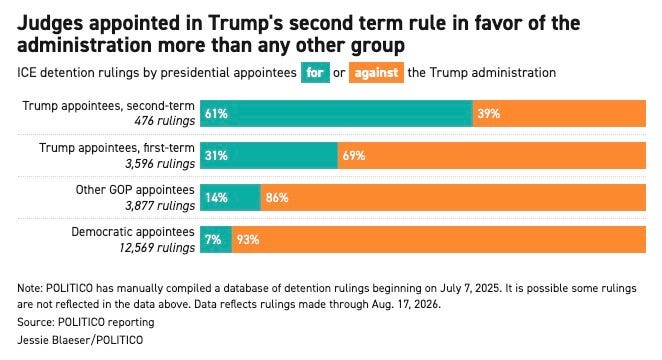
Seems pretty bad—but then, there are some silver linings. One, Trump is way off the pace of his first term in filling federal court vacancies, in part because there are many fewer vacancies for him to fill. And two, he hasn’t gotten any new cracks at another SCOTUS vacancy yet—and God willing he never will.
NOW HERE’S A PUZZLER: “President Trump’s half-built White House ballroom is a 90,000-square-foot embodiment of a recurring legal conundrum,” reports the Wall Street Journal. “What happens when a boundary-pushing president moves faster than courts can keep up?”
What a mind-bending paradox indeed! The report continues:
Construction of the “concrete-and-steel superstructure,” [the Trump administration says], has already advanced so far that it would be “practically impossible” to stop now, let alone tear down what has already been built.
Two lower courts have ruled that the ballroom project is probably illegal because Congress never approved it. But Trump has been allowed to build while the litigation proceeded. He has taken full advantage of that dispensation, leaving the Supreme Court in a pickle as the grace period is set to expire this week. [Emphasis added.]
The solution seems pretty simple: The president shouldn’t be allowed to continue to do something that’s probably illegal. That’s more or less what the word “illegal” means—you’re not allowed to do it.
Frustrated sarcasm aside, the Journal article is really about how the administration is rushing, in a whole bunch of areas, to create facts on the ground before the courts can intervene. It’s an important subject worthy of attention.
It’s also why the Supreme Court should block further construction immediately and indefinitely, and why the next Congress and/or president should demolish Trump’s construction—as a demonstration of the supremacy of the law and the government’s fealty to it.
Besides, if the Reflecting Pool saga is any indication of Trump’s preference for contractors, that ballroom won’t be safe to stand in.
Cheap Shots

According to Marsh, Borregard was “posting in his own capacity” on the party’s official Facebook account. “We advised him that the party is not endorsing any independent candidates or candidates from other parties for this cycle and he edited that post accordingly.”
Bulwark LIVE Member Presale ends tonight! Get the details, access code and ticketing links, here: https://www.thebulwark.com/p/the-good-fight-tour-is-coming
No one has made a clear picture to me what all of these data centers are for other than MOAR POWERR!!! The data centers haven't been built yet, but the tech is advancing fast just fine. Where is the optimization to the LLMs first? What about addressing the inefficiencies with current data centers? Why do they need to be so big vs. smaller more spread out centers?
The goal is to take away your ownership of computers and compute power. They are A) starving the market and pushing folks to stripped down machines that rely on data centers for processing power and B) hoovering up every last iota of data that flows through their channels to then feed into their AI learning, and C) passing money around to each other, creating a circle jerk of inflation that will explode and crater the market with them.
I am not against AI, I am against the techoligarchy and their plans for us. AI is just a tool and one that has been around for decades - we just now have the processing power to make it a useful tool.