How the Roberts Court Is Blowing Up American Politics
In the term that just ended, the right-wing justices continued their campaign to elevate the presidency, while discarding vital protections and longstanding precedents.

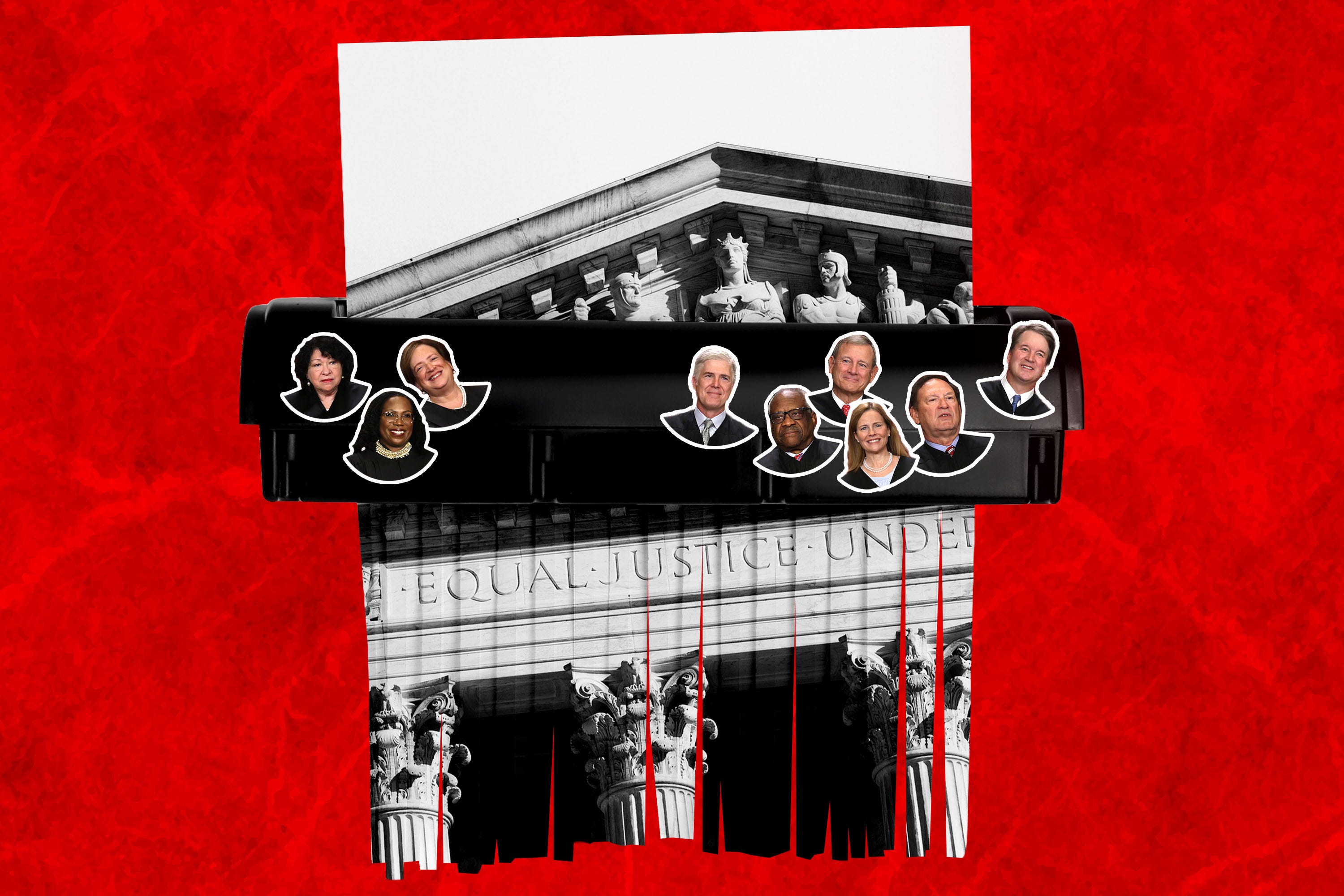
LAST WEEK, THE SUPREME COURT issued its final rulings for the term, including, most prominently, a 5–4 decision upholding the Constitution’s guarantee that individuals with a U.S. birth certificate are U.S. citizens.1 Some are heralding the decision as a win for the rule of law and a rebuke of Donald Trump. But while it’s true that the decision did smack down Trump’s executive order purporting to end birthright citizenship, the fact that the decision was so fractured epitomizes what’s insidiously wrong with this Court.
As for the overall balance of this term, with a handful of exceptions, the six-justice right-wing majority continued its sordid work of structurally reshaping the balance of power under the Constitution to elevate presidents, corporations, guns, and the Republican party at the expense of the individual and the collective.
Let’s go through some of the lowlights of the term.
The Court released a pair of harebrained decisions addressing whether Congress can constitutionally constrain the president’s power to remove executive branch officials. For nearly a hundred years, the Court’s position was that when Congress creates agencies it can make it hard for new presidents to easily pack them with loyalists. In one of the rulings, Trump v. Cook, Chief Justice John Roberts wrote for the majority that Congress can continue to constrain the president’s elusive removal power—but only for the Federal Reserve because that involves monetary policy. Roberts justified the carveout based on the history of “de facto” central banks that existed before the Fed—never mind that the first of those, the Bank of North America, antedated the Constitution, and never mind that these earlier banks bear little resemblance to the Fed.
But in the other case, Trump v. Slaughter, Roberts wrote that for other agencies, the president has an unlimited constitutional prerogative to fire executive branch officers at any time for any reason—even though the Constitution says nothing about presidential removal power at all, and even though bedrock Supreme Court precedent to the contrary stretches back to 1935.
Underlying this decision is the right-wing theory of the so-called “unitary executive,” which also animated the 6–3 majority’s disastrous decision in 2024 manufacturing criminal immunity for President Trump so long as he uses official presidential power to commit crimes. We now have epic corruption in the Oval Office. But that hasn’t dissuaded these justices from continuing to crown an untouchable American king.
WITH THE MIDTERMS APPROACHING, commentators closely watched this term’s voting and campaign finance cases. In uplifting news, the Court upheld a Mississippi law that allows for the counting of ballots postmarked by but received after Election Day—but the right-wing justices still destroyed two hard-fought pillars of campaign and voting rights legislation, effectuating another substantial transfer of power from regular people to the already powerful.
Both rulings override Congress’s Article I power to enact laws on behalf of the voting public. In National Republican Senatorial Committee v. Federal Election Commission, Justice Brett Kavanaugh, writing for the Court, cited the First Amendment to overrule the Court’s precedent from 2001 and strike down a Watergate-era federal cap on coordinated spending between candidates and political parties. Kavanaugh heralded that the decision “treats all political parties equally. It will allow all political parties—including the DNC and RNC and the respective Senate and House campaign committees, as well as other parties and party committees—to participate more freely and compete more fully in the political process, and to coordinate more closely with their candidates.”
Never mind that the decision simultaneously dilutes the power of regular voters. In her dissent, Justice Elena Kagan explained the implications of rewriting these rules: “A contribution limit of $7,000 will do no good if a donor can use a political party as a conduit to give the candidate hundreds of thousands more.” Vice President JD Vance was one of the case’s original plaintiffs.
In Louisiana v. Callais, the same 6–3 majority dealt what might be the final death blow to the 1965 Voting Rights Act, ruling that Louisiana’s 2024 congressional map was an unconstitutional racial gerrymander. Section 2 of the law allows states to create majority-black districts to remedy historical vote dilution based on race. A group of self-described “non-African Americans” sued over Louisiana’s creation of a second majority-minority district (out of six total) in a state with a 33 percent black population, after a federal judge struck down a prior, less-representative map. Writing for the Court, Justice Samuel Alito stated that “the Constitution almost never permits the Federal Government or a State to discriminate on the basis of race,” and basically held that “compliance with the Voting Rights Act” was not among “our very short list of compelling interests that can justify racial discrimination.” Remedying discrimination, in other words, is itself now constitutionally discriminatory.
We will undoubtedly see more egregiousness as a result of the majority’s novel view that the Constitution is “colorblind,” notwithstanding the irrefutable fact that the post-Civil War amendments were specifically designed to remedy enslavement and discrimination based on skin color. Indeed, following the Court’s ruling, Republican leaders in several Southern states have moved to hurry out newly redesigned maps of congressional districts.
ON THE IMMIGRATION FRONT, the 6–3 Court gave Trump a win in his war on migrants, allowing officials to turn away asylum seekers before they physically touch U.S. soil, a slick maneuver designed to bypass yet another act of Congress that allows those who “arrive in” the country to seek asylum and avoid deportation until their application is processed. In addition, the 6-3 majority cleared the way for Trump to end Temporary Protected Status for Haitians and Syrians who had been authorized to stay in the United States under the 1990 immigration program based on the government’s determination that it was unsafe to return to their home countries. Not only did the justices endorse the Trump administration’s abrupt end to the program, but they held that federal courts are barred from even hearing legal challenges to then-Homeland Secretary Kristi Noem’s decision to end the TPS designations.
With respect to the rights of individuals to invoke the Constitution against governmental overreach, the Court issued three rulings that, according to Erwin Chemerinsky, dean of UC Berkeley’s law school, demonstrate how “the Court is very hostile to trans rights.” In Chiles v. Salazar, it ruled that Colorado’s conversion-therapy ban for minors discriminates against counselors’ right to free speech inside a therapy session.2 And in West Virginia v. B.P.J. and Little v. Hecox, a 6–3 majority upheld transgender sports bans in two states; twenty-five other states have similar laws.3
It was a good term for guns. In Wolford v. Lopez, Justice Alito wrote another opinion for the 6–3 majority that struck down under the Second Amendment a Hawaii law that prohibits firearms on private property open to the public without the express consent of the property owner. The Court flipped Hawaiian state legislators’ choice to default to a no-guns-on-private-property rule; property owners must now post signs affirmatively prohibiting firearms on their property to keep strangers’ guns out.
The Court did throw a few more bones to the tens of millions of Americans who are disgusted with the far-right swing of the country. The justices preserved (for now) women’s access by mail to a drug used in the most common method of abortion, rejecting lower-court restrictions, and struck down Trump’s sweeping tariff program. In the latter case, the Court upheld the plain language of the Constitution (whew), giving Congress exclusive control over tariff policy.
But make no mistake, this is not an unbiased, rule-of-law Court. Its offering of a few small band-aids will not prevent an impending death by a thousand cuts. And the victim—in addition to the innumerable Americans and immigrants who will be harmed by these rulings—is the Constitution itself.
Looking back on the term, it’s hard not to be sympathetic to the argument made by one forty-year professor of constitutional law that some of the justices—the ones who would have obliterated the language of the Fourteenth Amendment at Trump’s behest—should be impeached. Others might not yet go that far. But this term made clearer than ever the need for serious congressional and public scrutiny of the dominant justices’ fidelity to their oaths.
The decision in the birthright citizenship case, Trump v. Slaughter, had six justices supporting the majority opinion, but one of the concurring justices, Justice Brett Kavanaugh, did not support the majority’s constitutional reasoning.
In this case, liberal justices Kagan and Sotomayor joined with the six-justice right-wing majority.
In the transgender sports cases, the 6–3 split was over whether the law violated the Equal Protection Clause; the justices were unanimously in agreement that the state ban under question did not violate Title IX.
 | A guest post by
|
The premise of "one person, one vote" assumes a baseline of political equality at the ballot box. However, wealth in any society is distributed unequally. When you equate money with voice, you legally protect a system in which the volume of a citizen’s voice is directly proportional to their net worth.
The architects of early US governance debated endlessly about the dangers of "factions" and the undue influence of property and wealth on the republic. While they were far from perfectly egalitarian, modern mechanisms of infinite financial amplification, such as Super PACs and dark money networks, introduce a scale of influence that completely bypasses the geographic and individual representation the House and Senate were initially designed to protect.
This court's ruling on financial contributions to political operations accelerates the realignment toward a government that is no longer responsive to the electorate but to the money that funds their private clubs' political ambitions.
When the electorate realizes that their single vote cannot compete with a multi-million-dollar media blitz, the result is deep civic apathy and a feeling that the system is entirely rigged.
This court is a disgrace, corrupting the most fundamental promise: "We the people"
IF the Democrats have the Trifecta by 2029, we need a movement for radical reform (a Project 2029) which will re-center Congress as the dominant branch in national politics, and which will engage in a direct confrontation with this MAGAfied-Conservative court.
It is a moral certainty that Trump will issue a self-pardon, as he leaves office, along with his en masse pardons of Regime criminals (including all ICE agents). The 'Radical Democrats' in Congress need to seize on this as the predicate for drafting legislation that enables Congress to CANCEL Presidential pardons. And then the Congress needs to use this power, canceling ALL of Trump's pardons, so that the DOJ can proceed to prosecute those who have committed actual crimes.
This Conservative Court will attempt to bar the way, citing the Constitution. But the Congress can also read the Constitution, and the text does *not* state that the pardon power is "absolute," and the evolution of Executive Supremacy in our system makes it necessary that the Congress have a means to check rank abuses of presidential power like en masse pardons for criminal conduct.
So what will follow is an open political struggle between the Roberts Court and Congress, on this issue; a struggle in which Congress has MANY tools to bring to bear against the Justices (on up to and including Court-expansion). Like it or not, thanks to MAGA we live in radical times - and the new Radical Democrat Congress needs to know what time it is. The Roberts Court has created an Executive that is above the law; it cannot stand.