The Dystopian Novel Fueling the Far Right’s Migration Myths
From Ceuta to Washington, hard-right leaders regularly cite Jean Raspail’s 1973 novel to transform real-world border events into apocalyptic threats to Western civilization.

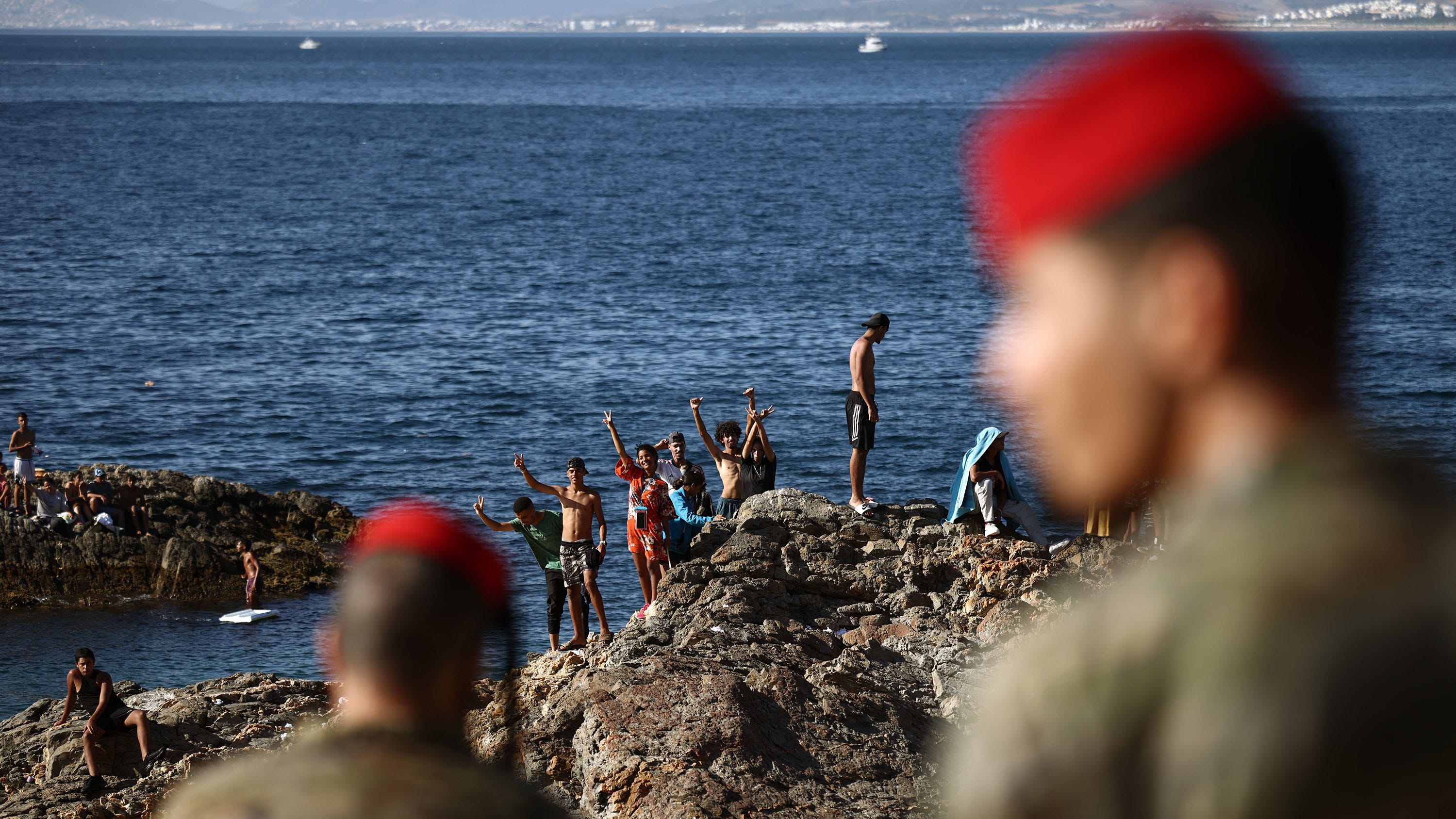
SOME 72,000 PEOPLE—mostly Moroccans—forced their way into the small Spanish North African city of Ceuta on July 30 and 31. The imagery was arresting, but the real wave was less about migration than misinformation.
The first case of misinformation seems to have caused the throng: a rumor spread on social media claiming the Spanish border was about to open.
The second case of misinformation came from the European and American far right, which quickly spread gloom-and-doom rhetoric about a clash of civilizations, disregarding the complex and still unclear circumstances behind a tragedy that led to the deaths of nearly a hundred migrants.
For the far right, the situation was not complicated at all. Right-wing voices swiftly and loudly presented the crisis as the prophetic fulfillment of a fifty-year-old book. Jean Raspail’s The Camp of the Saints, published in 1973, envisions France swamped by an invasion of a million third-world migrants arriving from the sea.
The language and imagery of Raspail’s novel have made it a formative text for the anti-immigrant right, both in Europe and America. Each new migrant crisis, no matter how transitory, is taken as confirmation of the book’s vision, fueling an unrealistic and ultimately violent worldview. The stampede in Ceuta—which has a population of about 84,000—is no exception.
As images of hundreds of people streaming through open gates in Ceuta’s border walls are disseminated online, right-wing outlets and writers reached reflexively for Raspail as a reference. Rod Dreher, a prominent conservative blogger once close to Vice President JD Vance, called it a “real-life Camp of the Saints,” elsewhere writing that the novel “foresaw exactly the kind of thing happening this week.”
According to the Spectator in the U.K., “The scenes at Ceuta are eerily reminiscent of aspects of the infamous anti-immigration French novel, The Camp of the Saints by Jean Raspail.” Similarly, the Wall Street Journal reports that “the images could be from the dystopian pages of Jean Raspail’s 1973 novel The Camp of the Saints, in which a million hungry Indians sail to Europe and launch an invasion after landing in the French Riviera.”
An op-ed in Le Figaro, one of France’s oldest right-wing newspapers, further emphasized the analogy: “As in that book, reviled by right-thinking people, published 53 years ago (!), 60,000 young men, often teenagers, barefoot, many of them wearing nothing but swim trunks, literally overwhelmed in a matter of hours the small Spanish town of Ceuta.”
The comparison proved irresistible to politicians. Grégoire Houdan, a city council member for the far-right National Rally party in Rouen, asked: “How could one not think of that prophetic novel by Raspail, in which a vast flotilla advances toward the shores of a Europe too weary to resist, too guilt-ridden to defend itself? The Camp of the Saints was not a work of fiction. It was a warning.”
The right-wing takes seem to write themselves.
Yet, as with any prophecy worth the paper it’s written on, the far-right heralds tend to slip into a bombastic future tense to proclaim imminent disaster. For example, Stephen Miller, the White House deputy chief of staff for policy, declared in response to Ceuta, “The Democrats did this to America every single day for 4 years under Biden and will do it again. . . . Democrats will see your home trampled and stolen by invaders and they will rejoice.” In the U.K., Nigel Farage, leader of the populist Reform party, foretold that, “Before long many will be crossing the English Channel to enter Britain illegally.” Striking the same note, National Rally’s president, Jordan Bardella, said, “Tomorrow, they will be on our streets, against the will of the French people.”
All of this sounds like an old story. And indeed it is: These would-be prophets echo the epic and portentous tone of The Camp of the Saints, which can be encapsulated in one sentence: “Thus the river of words swelled beyond all measure, taking on the proportions of a flood that did not subside until Easter Monday, when it became certain that France was about to be invaded.”
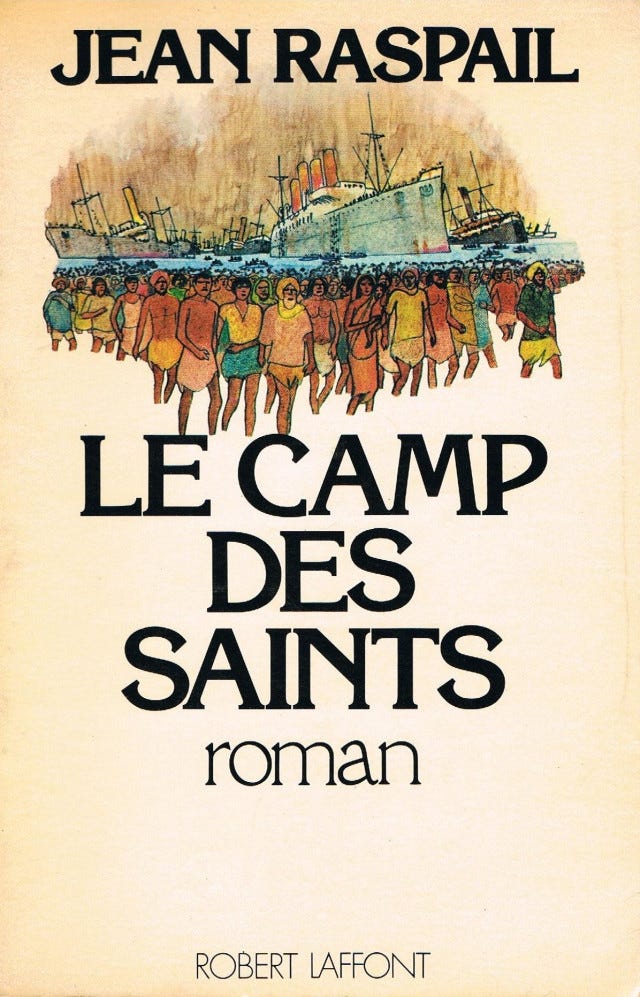
But there’s a catch to all this demographic fire and brimstone. The Camp of the Saints did not take place—neither the fictional events of the novel nor the far right’s depiction of the border-crossing at Ceuta as an invasion of Europe. According to the Spanish government, by August 1, hours after the breakthrough, 70,000 migrants had already been returned to Morocco—virtually all of them. Had they stayed, the migrants could not have left Ceuta to reach mainland Spain without passing through border control. Free movement within the European Schengen Area doesn’t apply in this exclave (or in Spain’s other North African city, Melilla). And despite sensationalist reports of a migrant invasion, Frontex recorded 178,000 irregular crossings across all of the EU’s external borders in 2025, the lowest level since 2021 (although border crossings in the Western Mediterranean did rise 14 percent between 2024 and 2025).
These facts don’t matter to the far right: Its apocalyptic vision is as flexible as it is nightmarish. The “migration catastrophe” is akin to end-of-the-world narratives that are constantly postponed to an ever-more-distant “after.” The far right lives for tomorrow, and tomorrow, and tomorrow.
THE TREATMENT OF The Camp of the Saints as a revelation of a latent threat is as old as the book itself. Raspail, who died in 2020, long enjoyed a reputation as a seer of Western demise. In the 1980s, Jean Cau of Le Figaro littéraire described the writer as “the relentless historian of our future.” Among right-wingers, Raspail is treated as a prophet and his novel as a kind of revelation of the “Great Replacement,” which, according to its leading theorist Renaud Camus, is the process of supplanting a Western, white, and Christian population with foreigners bent on destroying Western civilization.
Raspail’s eschatological novel, although inescapably French, has found an audience on both sides of the Atlantic, partly because it foreshadows doom for the entire West. An English translation published in 1975 won appreciation from the white nationalist movement but also, strikingly, elements of the more respectable American right. In anti-immigrant circles, the book became so synonymous with migration from the Global South to Europe that when the white nationalist organization VDARE launched its website in 1999, it created a tag titled “The Camp of the Saints” to compile relevant articles. Likewise, the hard-right figure Pat Buchanan mentioned the novel in his 2001 anti-immigration screed The Death of the West in which he declared that “History has begun to imitate art”—a view shared by Stephen Miller.
Despite its cult status, the controversial English translation went out of print—at least, for a while. The hard-right publisher Vauban Books, named after Louis XIV’s military architect, whom the imprint casts as a champion of the “defensive doctrine of natural borders,” published a new translation in September 2025, hosting a release party at a bar supposedly favored by Trump administration staff and hangers-on. Shortly after Ceuta, Nathan Pinkoski, who wrote the preface of the new edition and has done much to promote Raspail in conservative intellectual circles, declared in First Things that “the novel’s relevance” comes from “anticipating the West’s abdication of responsibility,” claiming the “root of the crisis is not a material question but a spiritual sickness.” The humanitarian principles that supposedly emerged after World War II and Auschwitz would, in Pinkoski’s view, lead to the suicide of civilization by creating a culture unable to be tough on immigration.
IN PART CONDITIONED by The Camp of the Saints, the far right sees every migration crisis as a sign of civilization’s imminent collapse. Each border event, no matter how well managed, seemingly reinforces the book’s supposed insight. In 2011, the Arab Spring caused thousands of Tunisians to flee to the northern Mediterranean. At the same time, the eighth reprint of The Camp of the Saints ranked among French bestsellers. Indeed, of the 110,000 copies of the book sold in France since 1973, 40,000 were sold between 2011 and 2016. Again, following the 2015 migration crisis, Steve Bannon, the former Trump adviser, drew attention to the book, stating “the whole thing in Europe is about immigration. It’s a global issue today, this kind of global Camp of the Saints.”
The reaction to Ceuta confirms the interpretive drift of the novel. It is no longer read as a work of fiction, but as a theory on the verge of verification or a prophecy close to fulfillment. Real-world events and their circumstances are of little interest to the right: They become pretexts for emphasizing, once again, the visionary nature of Raspail’s work as a premonition of the Great Replacement.
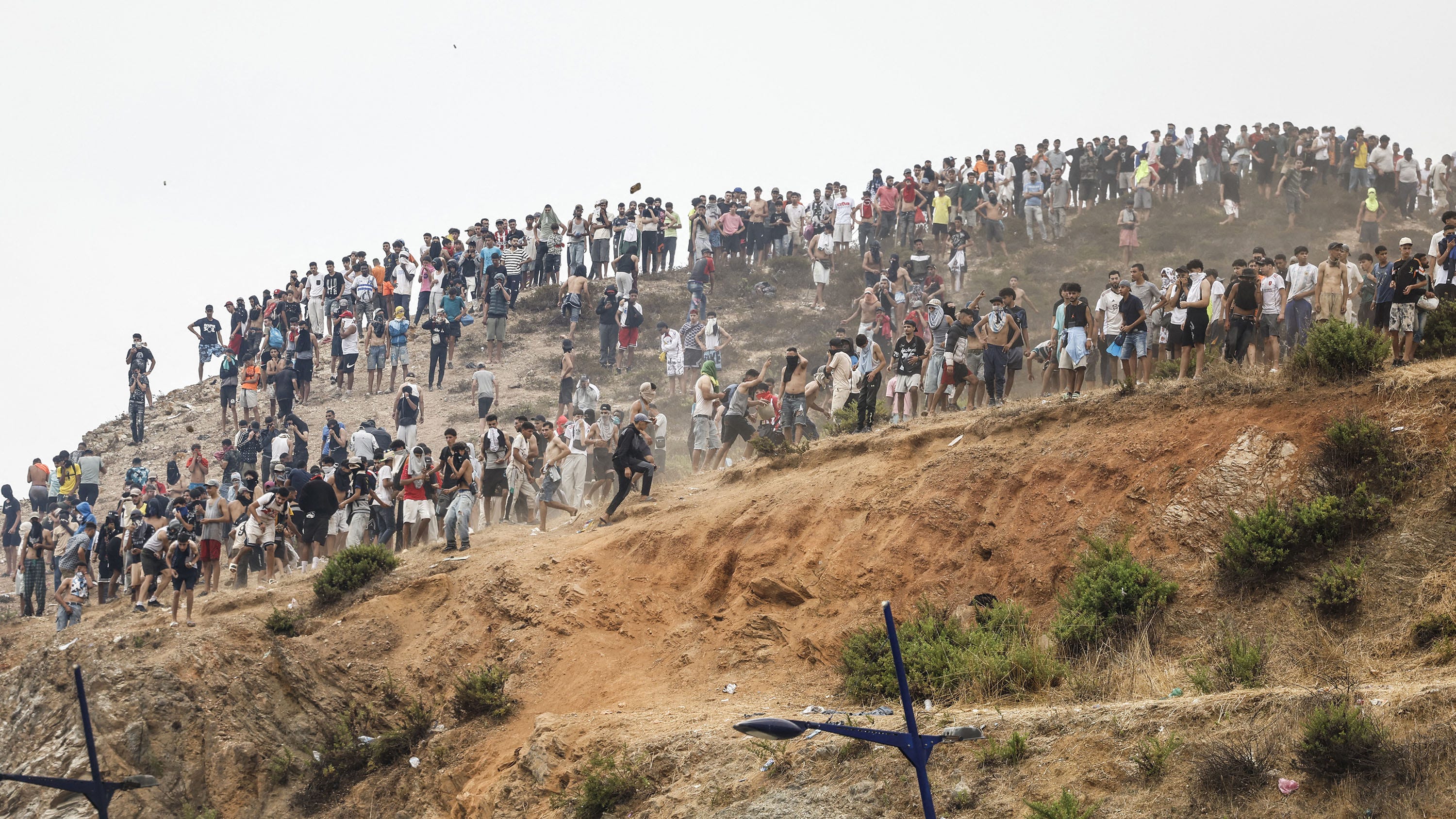
One value of these overheated interpretations is the way they reveal the far right’s fantasy-based rhetoric. Consider how the imagined threat has spread on X through the use of a “liquid” metaphor, which reinforces the image of Europe as a vessel on the brink of overflowing. “A tide of migrants is surging into Ceuta and storming the Spanish border,” said Éric Zemmour, president of the French far-right party Reconquête, referring to a “tsunami” of migrants. Jordan Bardella remarked: “This is an unprecedented deluge,” saying that “for several days now, thousands of migrants have been flooding into the Ceuta enclave.”
In this language, migrants are portrayed as a fluid, homogeneous, and threatening mass, whose movement is a wave or a flood threatening to overwhelm the banks and shore.
Raspail’s novel is full of such imagery, describing migrants as a “human tide,” “the flood,” “the human torrent,” and “a tidal wave of flesh and bone.” The far-right National Front—a precursor to National Rally—adopted the metaphor of “migrant submersion” in the 1980s. Over time, this expression—and the entire aqueous vocabulary—has become trite, and its correlation to reality is no longer questioned, at least among those who use it.
But let us consider how the metaphor operates. It imposes on the reader or listener the claim that migration is a natural disaster—or perhaps a divine punishment—inflicted upon the West and impossible to stem. Metaphors can short-circuit rational argumentation by arbitrarily drawing a connection between two radically different realities. We cannot trust metaphors that don’t justify the merit of such a connection. The persuasive power of images was highlighted by Haig A. Bosmajian in his 1966 study of Nazi rhetoric. He described the nearly “magical” effect of metaphors when used in a perverse way, transmogrifying people into pure threat: “Bolsheviks were not like a dragon, they were a dragon; the Jews were not like a demon or bacillus, they were both demon and bacillus.” Such metaphors are designed more to impress than to convince, by arbitrarily steering the discourse, suggesting judgments, implying connotations, and ensuring that they are accepted.
We can see the same effect in the far right’s use of martial language regarding Ceuta. Farage said, “Around 60,000 illegal migrants have now invaded Ceuta.” According to Elon Musk, “All military age males means it is an invasion,” comparing the images from Ceuta to the 2013 zombie movie World War Z. Zemmour contended that, “When thousands of men land on a Spanish beach, it’s not immigration, it’s an invasion.” While Sarah Knafo, member of Reconquête, said bluntly, “Ceuta has been invaded.”
Depicting migrants as invaders is a common social-Darwinist trope that assumes a clash of civilizations through the application of natural selection to the human species. Within this racist and Manichaean view, there are only two outcomes. Either the pure “us” must annihilate a corrupt “them,” or be overcome and exterminated. This metaphor and this mode of thinking ultimately legitimizes violence as a last resort required to defend civilization.
Once again, The Camp of the Saints pioneered this warlike imagery. Throughout its pages, Raspail portrays “the incredible invasion” of migrants as a “conquering army” whose weapon is misery. Raspail even goes beyond fiction, anticipating, in the preface to the 2011 reissue of the book, an alternative outcome to France’s invasion, one in which “the last isolated pockets held out, going so far as to embark on a kind of reconquista.” Failing that, such a scenario could be the subject of a future, “perilous” novel—one he was confident would be written, even if its author had yet to be born.
THE REASON SO MANY French politicians and commentators were so quick to cite The Camp of the Saints isn’t just that it’s a French novel—it’s also that they’re all looking toward the elections next year. However short-lived, the Raspail-like imagery coming out of Ceuta—all of which shows excited young men streaming in, none of which shows them returning home—will serve as a rallying point to further entrench the term “remigration” in public discourse.
The idea of remigration, or reverse migration, arose from the white identitarian movement but has been gradually mainstreamed by far-right parties, including the Trump administration (often through its social media posts). It calls for gradual, mass deportations of migrant populations back to their countries of origin, arguing that they have failed to assimilate and describing their presence as a form of colonization of the West. Ultimately, the goal is to restore a white demographic majority in Western countries.
A corollary to the Great Replacement, remigration goes beyond pseudo-observation: It is a call to action. “It is time to restore our borders and launch remigration,” said Zemmour after Ceuta. In the U.K., Farage promoted his party in similar terms: “Only Reform will use the force necessary to deport every illegal migrant.” And Martin Sellner, ultra-right activist and co-founder of the Austrian Identity Movement (IBÖ), averred that “The situation in Ceuta is a major danger, but also a major opportunity—why we must now increase the pressure.”
Sellner is not content with words. On July 22, the European Commission rejected his “Save Europe Act,” which had called for a freeze on new visas to “non-Western immigrants.” The EC rejected the bill on the grounds that its functioning would not be based on “migration-management criteria but on the ethnic, cultural or civilisational origin of the persons concerned.” In a snub to Brussels, he traveled to Ceuta to argue for the necessity of such a measure and “build resistance.”
Remigration is promoted in France by Polémia, a think tank founded in 2002 by Jean-Yves Le Gallou, a former member of the European Parliament for the National Front. The great majority of his posts about Ceuta use the hashtag #JUGEXIT, a call to cast off the alleged dictatorship of judges responsible for the “invasion” of Europe. In the meantime, Polémia, which purports to defend European identity and superiority, asks, “What if the human tide were to flow… in the other direction? The tens of thousands of undocumented migrants who cross the barriers at Ceuta are not an inevitability.” (In a similar vein, in America, Kevin Roberts, president of the Heritage Foundation, responding to a government taskforce on fraud and the alleged loss of a “high-trust society,” tweeted “Mass deportations would drastically help fix the problem, both socially and economically.”)
Le Gallou and Polémia are currently organizing a remigration forum in Paris on October 31, modeled after Martin Sellner’s “Remigration Summit” held in Portugal earlier this year. That conference brought together intellectuals, activists, and leaders of international identitarian political parties, from Germany’s AfD to Spain’s Vox, as well as Gregory Bovino, an architect of Donald Trump’s anti-immigration policy.
The Great Replacement, remigration, and hard-right politics still live in a set of images established in Raspail’s novel. And the far right takes every episode like Ceuta and forces it into Raspail’s framework. On a YouTube channel dedicated to identity-based political philosophy, Sellner described “the strategic mission of the intellectual,” which consists, in part, of “developing the idea of remigration.” But it also entails “a revolutionary theory . . . how do we get this idea to become politics?” Jean-Yves Le Gallou recently put this lesson into practice by publishing Remigration: For a Europe for Our Children (an English translation was released by the alt-right publisher Arktos). The Austrian remigration politician Martin Sellner wrote the foreword, proclaiming the program’s relevance. Of course, Le Gallou didn’t forget to pay tribute to The Camp of the Saints either.
 | A guest post by
|